A MODERN HEIRLOOM
Ное синџир
Ное синџир
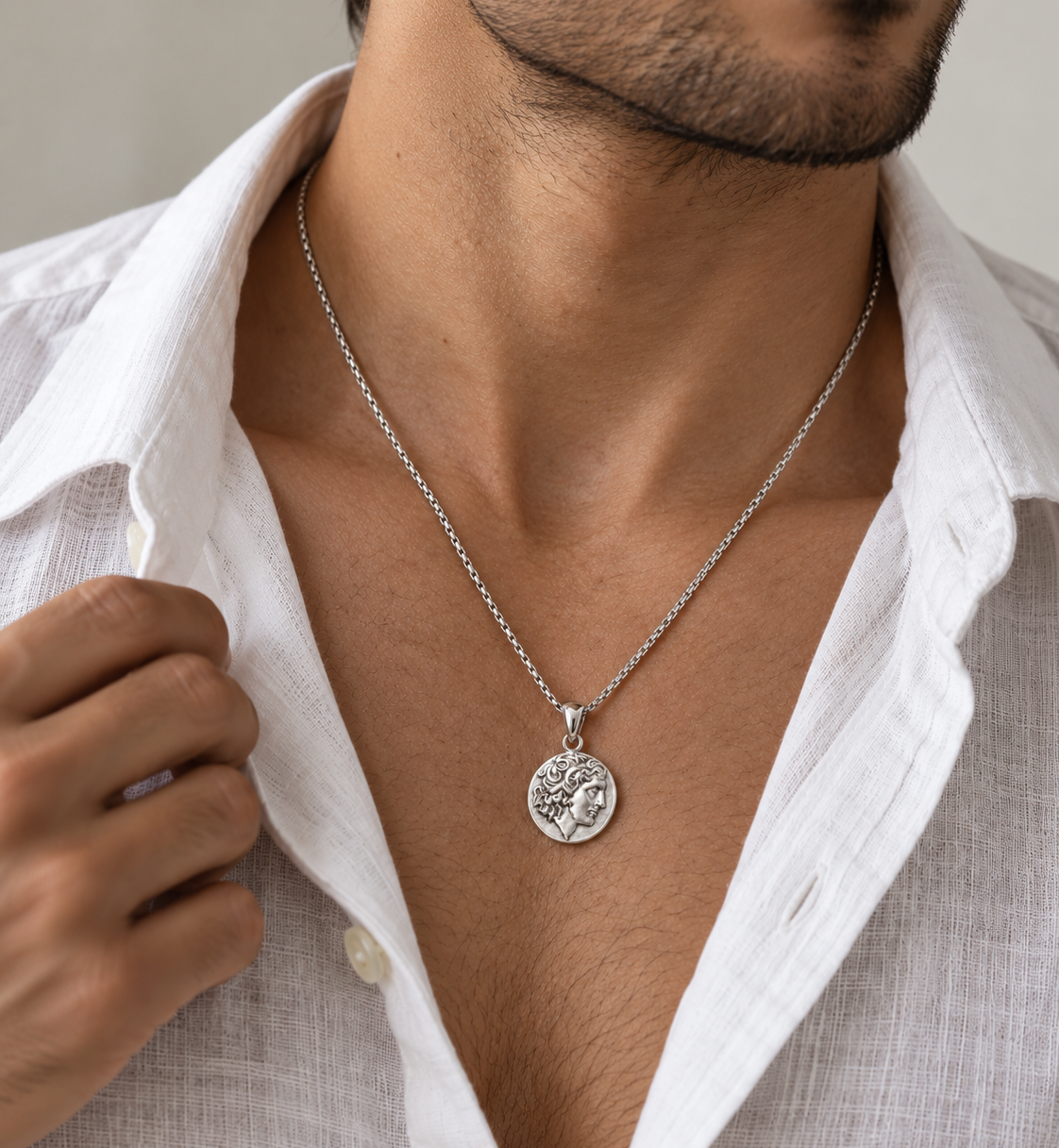
A portrait of Alexander the Great, set in sterling silver.
Не може да се вчита достапноста на подигање
Македонското сонце
Негувано речиси 3000 години од Македонците насекаде, Македонското сонце е без сомнение еден од најстарите, ако не и најстариот преживеан културен симбол во светот.
Details
Details
- 0.925 sterling silver
- Portrait of Alexander the Great
- Circular medallion form
- Pendant approx. 17 mm diameter
- Choice of chain style
- Choice of available chain lengths
- Selected chain included
Materials & Care
Materials & Care
Sterling Silver
The Alexander medallion and accompanying chain are crafted in 0.925 sterling silver. Sterling silver develops a natural patina over time, which can be gently restored using a soft silver polishing cloth.
Care
Avoid contact with perfumes, cosmetics, household chemicals and abrasive surfaces. Remove jewellery before swimming, exercising or using cleaning products. Clean gently with a soft, lint-free cloth and store separately.
Size & Fit
Size & Fit
The Alexander medallion measures approximately 17 mm in diameter.
Choose your preferred chain style and length from the available options. Different chains vary in width, structure and weight, allowing you to select a finer or more substantial profile.
Chain length will determine where the medallion sits when worn. Please refer to the specifications shown with each chain option when making your selection.
Delivery & Returns
Delivery & Returns
Complimentary shipping is available on jewellery orders.
Once dispatched, tracking details will be provided by email.
Made to order selections require additional production time, as noted below.
Returns and exchanges are subject to our Returns Policy.
In-stock pieces
Australia & NZ: 3-10 business days
USA, Canada, UK: 10-15 business days
Rest of the world: Contact us
Made to Order
Made to order pieces require approximately 4–6 weeks for production before dispatch.
Share

KING OF MACEDON
ALEXANDER THE GREAT
Alexander III of Macedon became king in 336 BCE, succeeding his father Philip II. Over the following thirteen years, his campaigns brought the Achaemenid Persian Empire under his control and carried his army through Egypt and deep into Asia before his death at Babylon in 323 BCE.
His image endured long after his lifetime, appearing and reappearing across sculpture, coinage and later artistic traditions.