
Cultural Stories
Alexander of Macedon
The king who carried Macedonian power from Pella to the edges of India, and left an image that the ancient world never forgot.
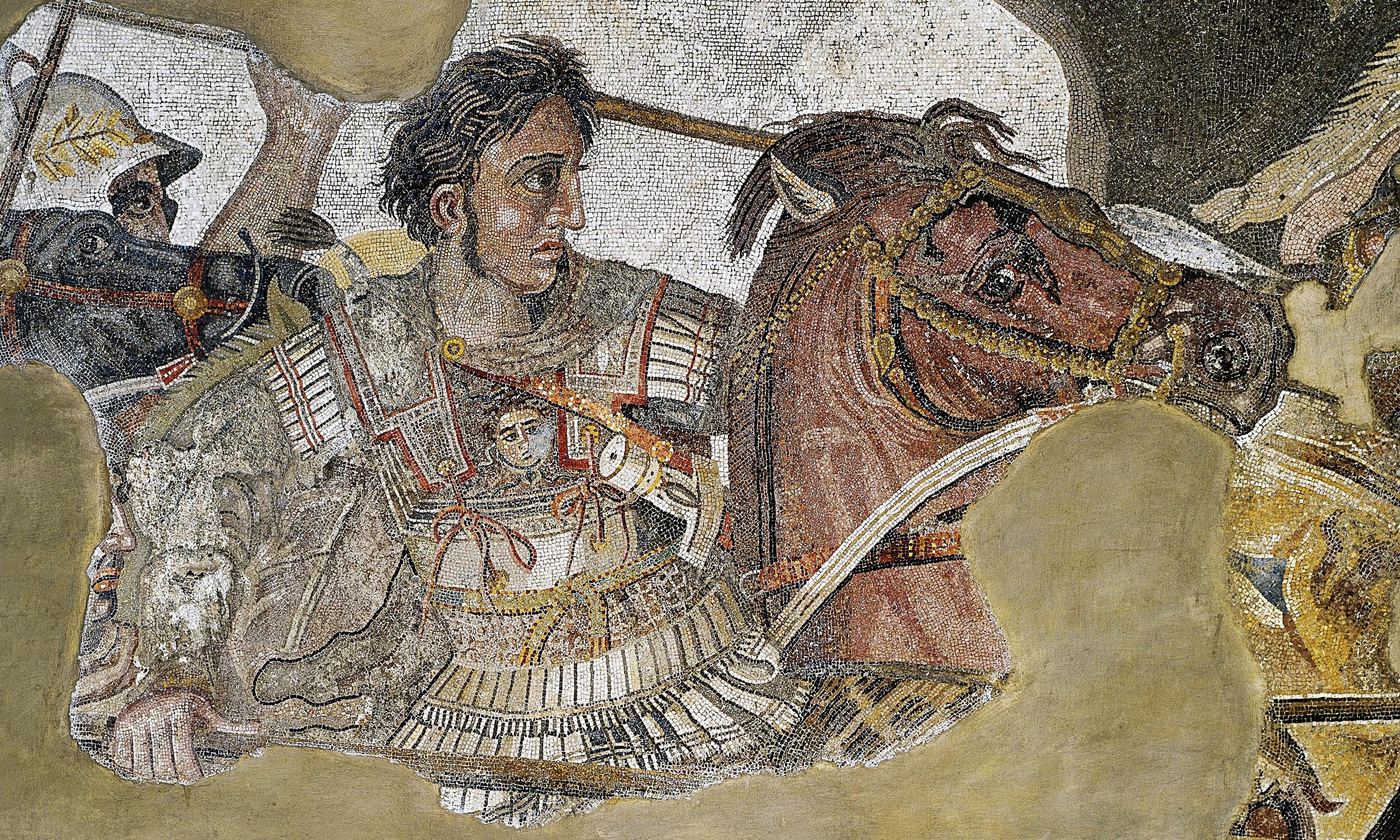
Alexander III of Macedon inherited a formidable kingdom, an army transformed by his father Philip II, and an unfinished campaign against the Achaemenid Persian Empire. Thirteen years later, he died in Babylon after extending Macedonian power from the Aegean to the Punjab. His empire did not survive intact. The cultural world created by its movement of soldiers, administrators, artists, languages and precious objects endured for centuries.
Born at Pella to Philip II and Olympias.
Acclaimed king of Macedon at twenty.
Crossed the Hellespont and began the Asian campaign.
Died at Babylon at the age of thirty-two.
The Argead court
Born into a kingdom in ascent
Alexander was born at Pella in 356 BCE. His father, Philip II, belonged to the Argead royal dynasty. His mother, Olympias, came from the Molossian royal house of Epirus. The court in which their son grew up was not simply a private household. It was the political centre of a kingdom being enlarged, reorganised and armed for unprecedented ambitions.
Philip II had rebuilt Macedonian military power through training, command structure, siege technology, cavalry and the long pike carried by the infantry phalanx. He also cultivated alliances and compelled rivals into submission. Alexander therefore inherited neither a weak frontier kingdom nor a ready-made world empire. He inherited a powerful state whose expansion still depended on the authority, loyalty and judgement of its king.
Ancient authors describe Alexander learning music, literature, horsemanship, hunting and warfare, the expected education of a Macedonian prince. Around 343 BCE, Philip appointed Aristotle of Stagira to teach Alexander and a circle of elite companions at Mieza. The later tradition that Alexander carried a specially annotated copy of Homer on campaign captures something important about his royal self-presentation, even though many details of his youth reached us through biographies written centuries later.


Macedonia and the Greek states
How Macedon broke the power of the southern cities
The world south of Macedonia was not a united Greek nation-state. It was a shifting landscape of independent cities, leagues and regional powers whose citizens usually placed loyalty to Athens, Thebes, Sparta, Corinth or another community before any wider collective identity. Their rivalries had exhausted them through generations of war. Philip II understood those divisions and used diplomacy, marriage alliances, money, garrisons and military force with equal skill.
Macedonia was organised differently. It was a territorial kingdom centred on an Argead monarch, a court of Companions, a landed warrior elite and an army personally bound to the king. Athens and many southern cities defined political life through the institutions of the polis, whether democratic or oligarchic. The Macedonian court instead placed kingship, military service, personal loyalty and elite competition at the centre of power. These differences were real and immediately visible to ancient observers, even though Macedonians and southern Greeks also shared religious cults, artistic forms, personal names and the use of Greek in diplomacy, inscriptions and court culture.
From influence to conquest
Philip's advance into Greek affairs was gradual. Intervention in Thessaly and the Third Sacred War gave him military access, prestige and a place within the Amphictyonic Council associated with Delphi. His influence divided the southern cities. Some leaders saw Macedonia as a threat to autonomy; others accepted Philip as an ally, protector or source of political advantage. There was no single Greek response because there was no single Greek government.
Athens became the centre of the most famous opposition. The orator Demosthenes spent years warning that Philip's treaties concealed a programme of domination. In the Third Philippic of 341 BCE, he denied that Philip was a Hellene and attacked him as a Macedonian outsider. His language was deliberately inflammatory:
“He is not only no Hellene, not only has he no kinship with Hellenes.”
Demosthenes, Third Philippic, 31
The passage is important evidence for hostility towards Macedonia, but it must be read as political oratory rather than a neutral ethnic survey. Demosthenes was trying to persuade Athenians to fight. Other evidence points in competing directions: the Argead kings claimed descent from Argos; Macedonian rulers participated in Panhellenic sanctuaries and festivals; and Philip presented the coming war against Persia through a Hellenic alliance. Ancient identity could be political, genealogical, linguistic, religious and cultural at once. It did not conform to the fixed national categories of the modern Balkans.
Chaeronea: the decisive Macedonian victory
In 338 BCE, Athens and Thebes formed the core of a coalition determined to stop Philip. Their armies met the Macedonians at Chaeronea in Boeotia. Philip commanded the Macedonian right. Alexander, only eighteen, fought on the left with senior commanders around him. Diodorus credits the prince with breaking the opposing line, while Plutarch associates him with the destruction of the Sacred Band of Thebes. The exact manoeuvres remain debated because the surviving accounts are brief and later.
The political result is clearer than the tactical detail. The Macedonian army defeated the leading military coalition of southern Greece. More than a battlefield had been lost. The capacity of Athens and Thebes to prevent Macedonian supremacy had been broken. The Athenian statesman Lycurgus later declared that the freedom of the Greeks had been buried with the dead of Chaeronea. His words reveal how at least part of the defeated world understood the result: not as voluntary unity, but as subjection to a northern kingdom.
Philip did not annex every defeated city directly. He used a more effective structure. In 337 BCE, the League of Corinth bound most Greek states into a common peace under Macedonian leadership, while Sparta remained outside it. Member states retained their own institutions, but they accepted Philip as hegemon, promised not to overthrow the settlements imposed after the war and supplied forces for the campaign against Persia. Macedonian garrisons at strategic points made the limits of this autonomy clear. The league gave conquest the language of alliance and converted military victory into an enduring political system.
Alexander and the destruction of Thebes
Philip was assassinated at Aigai in 336 BCE. Alexander, then twenty, was acclaimed king by the Macedonian army and recognised by the elite. News of the murder encouraged hopes that Macedonian power might collapse. Alexander marched south and compelled the League of Corinth to recognise him as hegemon. He then turned north against Thracian and Illyrian opponents.
In 335 BCE, while Alexander was campaigning beyond Macedonia, a false report of his death reached Greece. Thebes revolted, killed leaders associated with the Macedonian faction and besieged the Macedonian garrison on the Cadmea. Athens prepared to support resistance, while Demosthenes helped encourage the anti-Macedonian cause. Alexander responded with extraordinary speed, marching from the western Balkans into Boeotia before many believed he could have arrived.
The Thebans refused demands for submission. Macedonian forces and Alexander's Greek allies entered the city after fierce fighting. Thebes was destroyed, apart from temples and, according to literary tradition, the house of the poet Pindar. Diodorus reports approximately 6,000 killed and 30,000 enslaved, although ancient casualty figures cannot be independently verified. Alexander and the allied council shared formal responsibility, but the decision belonged to a political order sustained by Macedonian arms. The result was terror. Athens abandoned resistance, sent envoys and accepted Alexander's terms.
The ruins of Thebes announced that Macedonian rule over the Greek cities would be enforced, not merely proclaimed.
Resistance did not end
The destruction of Thebes secured Alexander's rear, but it did not transform resentment into loyalty. Alexander left Antipater in Macedonia with authority over Europe while the main army crossed into Asia. The expedition included Greek contingents supplied through the League of Corinth, yet its decisive institutions remained Macedonian: the king, senior command, Companion cavalry, hypaspists and phalanx. At the same time, thousands of Greek mercenaries served the Achaemenid king and fought against Alexander at the Granicus and elsewhere. The conflict was never a simple war in which all Greeks followed one chosen leader.
Sparta remained outside the league. In 331 BCE, King Agis III led a revolt while Alexander was in Asia. Antipater defeated the Spartans and their allies at Megalopolis, preserving Macedonian control. After Alexander died in 323 BCE, Athens and its allies launched the Lamian War in another attempt to remove Macedonian domination. These revolts show how deeply many communities resented the loss of autonomy. Other cities and political factions collaborated with Macedonia, whether from conviction, rivalry, calculation or fear. “The Greeks” therefore cannot be treated as a single mind, but resistance to Macedonian supremacy was persistent and sometimes ferocious.
Were Macedonians and Greeks the same people?
The ancient evidence does not support a simple slogan. Macedonians possessed a strong name, kingdom, royal tradition, army and political identity of their own. Southern writers regularly distinguished Macedonians from Greeks in political and military contexts, and hostile Athenians could portray them as outsiders or barbarians. Macedonian institutions also differed sharply from the civic structures idealised by cities such as Athens.
At the same time, the Macedonian elite participated in a wider Greek cultural world. Greek was used in surviving official inscriptions and became the language of Alexander's administration and the kingdoms that followed. The classification of the poorly preserved ancient Macedonian vernacular remains debated, although many modern specialists place it within Greek or very close to it. Shared language, cult and art did not erase political difference. Nor did political difference necessarily require complete cultural separation.
The most responsible conclusion is also the most revealing: Macedonians were a distinct ancient people and political community whose relationship with the Greek world was close, unequal, contested and changeable. Philip conquered the leading Greek powers. Alexander inherited that supremacy, destroyed its most dangerous rebellion and used the resources of the subordinated cities for a Macedonian-led war in Asia. The later spread of Hellenistic culture should not be projected backwards to turn that violent struggle for power into a story of effortless national unity.
Philip had already prepared the invasion of the Achaemenid Empire. Alexander retained his father's experienced commanders, the Macedonian phalanx and Companion cavalry, allied contingents, mercenaries, engineers, surveyors and support personnel. Before Alexander could challenge the Persian king, he first made certain that the Macedonian settlement imposed upon the Greek states could not be challenged behind him.
The Asian campaign
Across the Hellespont
In the spring of 334 BCE, Alexander crossed the Hellespont into Asia Minor. At the Granicus River, his forces defeated an army led by Persian satraps. Cities and strongholds across western Anatolia then submitted or were taken by force. The capture of Halicarnassus demonstrated that the campaign would depend on engineering and siegecraft as much as open battle.
At Gordium, Alexander encountered the famous knot associated with rule over Asia. Later writers preserved different versions of what happened. In one, he cut the knot with his sword. In another, he removed the pin that held the yoke together. The story belongs to the making of Alexander's legend because it presents him as a ruler who solved inherited problems by refusing inherited limits.
Issus, Tyre and Egypt
In 333 BCE, Alexander met Darius III at Issus. The narrow coastal plain restricted the larger Persian force, while the Macedonian attack drove towards the position of the king. Darius withdrew, leaving his family and royal baggage behind. Alexander treated the captured royal women as members of a court, an act that carried political meaning as well as personal drama.
He then moved south along the eastern Mediterranean. Tyre resisted for seven months. Alexander's engineers constructed a causeway to the island city, while siege engines and ships broke its defences. The victory was followed by mass killing and enslavement. Gaza also resisted and suffered heavily. These episodes sit beside Alexander's tactical brilliance and cannot be removed from an honest account of his reign.
Egypt submitted in 332 BCE. Alexander founded Alexandria near the western mouth of the Nile and travelled to the oracle of Amun at Siwa. Ancient accounts differ on what the oracle declared, but the visit strengthened his association with divine kingship. In Egypt he could be represented through pharaonic forms while remaining king of the Macedonians.
King of Asia
Gaugamela and the fall of an empire
Alexander left Egypt in 331 BCE and moved east. Darius prepared a battlefield near Gaugamela where his cavalry and chariots could manoeuvre. The Macedonian king used an angled advance to draw the Persian line outward, then drove a concentrated attack towards its centre. Darius again left the field. Babylon and Susa surrendered, giving Alexander access to royal treasuries on a scale beyond anything in Macedonia.
Persepolis, one of the ceremonial centres of Achaemenid kingship, was occupied and looted. Its palace complex was later burned. Ancient writers debated whether the destruction was calculated revenge, an intoxicated impulse or a symbolic end to the invasion that Xerxes had led against Greece. Modern historians remain cautious because surviving accounts were written long after the event and shaped by moral argument.
Darius was killed in 330 BCE while fleeing east. Alexander presented himself as his avenger and legitimate successor. The war changed character. It was no longer only an invasion led by the king of Macedon. Alexander now claimed authority over the lands, peoples and court traditions of the Achaemenid monarchs.

A changing kingship
Conquest altered the conqueror
From 330 to 327 BCE, Alexander campaigned across Bactria and Sogdiana, regions that correspond broadly to parts of modern Afghanistan, Uzbekistan and Tajikistan. Resistance was persistent and mobile. Victory required forts, settlements, local alliances and severe reprisals. In 327 BCE, Alexander married Roxana, the daughter of the Bactrian or Sogdian noble Oxyartes. She belonged to the Iranian cultural world, but describing her simply as Persian obscures the specific region and family from which she came.
Alexander retained elements of Achaemenid administration and admitted Iranian nobles into his court. He adopted selected Persian dress and attempted to introduce proskynesis, a court gesture that his Macedonian companions associated with worship when performed before a man. The policy failed among them. The episode reveals the problem at the heart of his later reign: one ruler was trying to command Macedonian companions, Greek allies, Persian aristocrats and numerous conquered peoples through forms of authority that did not mean the same thing to each audience.
The court also became more dangerous. Philotas was executed after being accused of failing to disclose a conspiracy. His father Parmenion, one of the most senior Macedonian commanders, was then killed on Alexander's order. In 328 BCE, during a drunken quarrel, Alexander killed Cleitus the Black, the officer who had once saved his life at the Granicus. Ancient authors treated the killing as a moral crisis and a sign of how far the king had moved from the reciprocal customs of the Macedonian court.


The eastern limit
Hydaspes and the refusal at the Hyphasis
Alexander crossed the Hindu Kush and entered the Punjab in 327 BCE. At the Hydaspes River in 326 BCE, near the modern Jhelum, he faced King Porus and an army that included war elephants. The Macedonians crossed the swollen river away from the main camp, forced a battle and defeated Porus. Alexander restored him as a subordinate ruler and enlarged his territory, an example of conquest followed by pragmatic local government.
Bucephalus died around this stage of the campaign, although the ancient evidence does not establish with certainty whether he died from wounds, age or exhaustion. Alexander founded a city named Bucephala in his honour. The famous horse belongs to both biography and legend, but the commemoration itself reveals how the king turned personal loyalty into imperial geography.
At the Hyphasis River, usually identified with the Beas, the army refused to march farther east. Years of campaigning, monsoon conditions and reports of powerful kingdoms ahead had exhausted the soldiers. Alexander withdrew after days of protest. The decision was not a mutiny near the Ganges and the battle with Porus did not take place in the Hindu Kush. The geography matters because it restores the scale and sequence of the campaign.
The return was costly. Part of the army moved by sea under Nearchus. Alexander led another force through the Gedrosian desert, where heat, thirst and supply failures caused severe losses. By 324 BCE he was back at Susa, arranging mass marriages between members of his court and women from Iranian noble families, incorporating Asian soldiers into the army and confronting resentment among Macedonian veterans at Opis.
The last days
Babylon and a kingdom without its king
Alexander entered Babylon in 323 BCE while preparing an expedition into Arabia. After a series of banquets, he developed a fever that worsened over several days. The surviving narrative sources preserve details, rumours and later theories, but no diagnosis can be established with confidence. Poisoning has never been proven. Alexander died on 10 or 11 June 323 BCE, aged thirty-two.
He left no adult heir. His half-brother Philip III Arrhidaeus and the posthumous son born to Roxana, Alexander IV, became joint kings under regents. Real power lay with the commanders. The ensuing Wars of the Successors did not divide the empire neatly into four kingdoms at the moment of his death. Decades of conflict eventually produced major Hellenistic dynasties, including the Antigonids in Macedonia, the Ptolemies in Egypt and the Seleucids across much of western Asia.
Alexander's body was taken to Egypt and ultimately displayed at Alexandria. The exact location of his tomb was later lost. The so-called Alexander Sarcophagus in Istanbul was not his coffin. It was made for a ruler of Sidon and received its modern name because its carved battle scenes include a figure identified as Alexander.

Evidence and legend
How Alexander became Alexander the Great
No complete contemporary biography of Alexander survives. Diodorus, Curtius Rufus, Plutarch, Arrian and Justin wrote generations or centuries after his death, drawing on earlier works that are now lost. Their books preserve indispensable evidence, but also court propaganda, moral lessons, literary drama and stories polished by repetition.
This is why the most famous scenes must be handled carefully. Bucephalus, the Gordian knot, the visit to Siwa and the king's final words may contain historical memory, yet their surviving forms also serve narrative purposes. Archaeology, inscriptions, coins, Babylonian records and the geography of the campaigns provide independent points of comparison.
History does not diminish Alexander by separating evidence from legend. It reveals a figure more complex than either worship or dismissal allows.
The title “the Great” was not the everyday royal name used during his lifetime. He was Alexander III, king of the Macedonians. Greatness was constructed after his death through military memory, ruler cult, portraiture, coinage, literature and imitation. Roman commanders studied him. Medieval traditions transformed him. Persian, Jewish, Christian and Islamic texts placed him within their own intellectual worlds. Few ancient rulers were remembered across so many languages and cultures.
Cultural memory
An enduring Macedonian name
Alexander's historical title is direct: he was king of Macedon, the son of the Macedonian king Philip II, and commander of an army whose decisive institutions were created within the Macedonian kingdom. His life later became part of the shared history of every region his campaigns touched, and his image acquired meanings far beyond the land of his birth.
For Macedonians today, Alexander remains connected to the name Macedonia, to Pella and Aigai, to royal imagery, the lion, the sun, the phalanx and the coinage of the ancient kingdom. That connection is cultural memory, not a substitute for careful history. It is strongest when the evidence is allowed to speak plainly, without invented anecdotes or modern territorial claims.
Objects have carried this memory with unusual force. Coins compressed kingship into metal small enough to cross an empire. Engraved images, royal emblems, armour, vessels, mosaics and carved stone survived long after political borders shifted. Their materials still make the ancient Macedonian court visible: silver marked authority, gold marked royal power, and repeated symbols made identity recognisable across distance.
Alexander endures because his story holds both achievement and cost. He was a brilliant commander and a ruthless conqueror, an heir to Philip's state and the maker of a new imperial court, a Macedonian king whose afterlife became global. The legend is immense. The documented life is more compelling.
Explore genuine ancient Macedonian coins and objects connected to the material world of the kingdom.
References and further reading
Sources
- Arrian, Anabasis of Alexander, translated by P. A. Brunt, Loeb Classical Library, Harvard University Press, 1976-1983.
- Plutarch, Life of Alexander, in Parallel Lives, translated by Bernadotte Perrin, Loeb Classical Library, Harvard University Press.
- Diodorus Siculus, Library of History, Book 17, translated by C. Bradford Welles, Loeb Classical Library, Harvard University Press.
- A. B. Bosworth, Conquest and Empire: The Reign of Alexander the Great, Cambridge University Press, 1988.
- Pierre Briant, Alexander the Great and His Empire: A Short Introduction, Princeton University Press, 2010.
- Ian Worthington, By the Spear: Philip II, Alexander the Great, and the Rise and Fall of the Macedonian Empire, Oxford University Press, 2014.
- Eugene N. Borza, In the Shadow of Olympus: The Emergence of Macedon, Princeton University Press, 1990.
- Joseph Roisman and Ian Worthington, eds., A Companion to Ancient Macedonia, Wiley-Blackwell, 2010.
- Jonathan M. Hall, Ethnic Identity in Greek Antiquity, Cambridge University Press, 1997.
- Elizabeth D. Carney, Olympias: Mother of Alexander the Great, Routledge, 2006.
- Waldemar Heckel, Who's Who in the Age of Alexander the Great, Wiley-Blackwell, 2006.
- Demosthenes, Third Philippic, especially sections 30-33.
- Museum of Cycladic Art, Chaeronea, 2 August 338 BC: A Day That Changed the World.
- UNESCO World Heritage Centre, Archaeological Site of Aigai.
- The Metropolitan Museum of Art, Art of the Hellenistic Age and the Hellenistic Tradition.
- Jona Lendering, Alexander the Great, Livius.
- World History Encyclopedia, Alexander the Great.