
The Macedonian Sun
From royal Macedonia to medieval churches, folk ornament, diaspora memory and modern jewellery: the long life of a radiating form.
To understand why the Macedonian Sun still carries such emotional weight today, archaeology is only the beginning.
The sixteen-rayed starburst made famous by the royal tomb discoveries at Aigai belongs to an ancient royal world of gold, painted tombs, ceremonial weapons and dynastic power. Yet the later history of the radiating form is just as compelling. Across Macedonia, stars, sunbursts and rosettes continued to appear in churches, frescoes, sacred painting, personal ornament, women's regalia and domestic carving. In the twentieth century, the sun became a language of freedom in the anthem and state emblem. In the 1980s, the exact sixteen-rayed flag was already being carried by Macedonians in the diaspora before an independent Macedonian state adopted it in 1992.
The history is therefore neither as simple as “the same emblem was used unchanged for 2,300 years” nor as simple as “the symbol was invented in the 1990s”. What survives is something more interesting: an ancient royal form, a much wider visual language of radiance, and a modern Macedonian attachment that developed through archaeology, religion, folk culture, political history and community memory.
In Gold: the ancient royal image
Where the sixteen rays enter the archaeological record
Aigai was the first capital of the ancient Kingdom of Macedonia and remained its royal burial centre even after political power shifted elsewhere. UNESCO describes the site as preserving the monumental palace, theatre, sanctuaries and an extensive royal necropolis with hundreds of tumuli.1
In 1977–78, excavations led by Manolis Andronikos uncovered monumental tombs beneath the Great Tumulus. The finds were extraordinary: painted façades, armour, silver vessels, ivory, gold wreaths and funerary objects of exceptional workmanship. Tomb II has traditionally been identified with Philip II, although the identities of some royal burials have been debated in scholarship. The royal Macedonian context itself is not in doubt.1

The object that made the sixteen-rayed form world-famous
Inside Tomb II stood a gold funerary chest, or larnax. Across its lid is the image now recognised around the world: a brilliant sixteen-rayed starburst arranged around a circular centre.
Its visual force is immediate. Long and short rays alternate. The centre anchors the composition. On hammered gold, the geometry seems almost to emit light. The design is both disciplined and alive, which helps explain why it remains legible whether enlarged across a flag or reduced to the scale of a pendant.

Ancient Macedonian imagery, however, was not limited to one exact sixteen-rayed pattern. Eight-, twelve- and sixteen-rayed forms appear across coins, shields, ceramics and other objects. Jovan Jonovski's heraldic and vexillological survey, drawing on archaeological literature, records a sixteen-rayed form on ancient ceramic cups from Ohrid, a twelve-rayed sun at the centre of Macedonian shields from Bonče near Prilep, eight-rayed forms on coins and shields, and the famous sixteen-rayed larnax at Aigai.2
What the ancient evidence supports
The starburst belonged to a wider ancient Mediterranean repertoire, but it acquired a particularly strong association with the royal and military visual world of ancient Macedonia. The evidence does not establish a single fixed interpretation for every number of rays.
A symbol inside a world of ceremony
The gold larnax should not be imagined as a modern logo placed in isolation. It belonged to an intensely visual royal environment. Architecture, weapons, armour, textiles, jewellery, painted walls and funerary ritual all communicated rank and power.
The tombs at Aigai preserve colour as well as gold. Their wall paintings reveal that ancient Macedonian elite culture was not the pale marble world that ruins can suggest today, but one of saturated pigment, elaborate dress, horses, foliage, mythological scenes and precious materials.
That context is important because symbols acquire meaning from where they appear. A radiating star on a royal funerary object carries a different weight from the same geometric form used generically elsewhere.

The ancient image matters. But the modern Macedonian relationship with the Sun cannot be explained by one tomb alone.Naš Nakit · Cultural Stories
The Sun through sacred Macedonia
The history does not disappear for two thousand years
This is the part of the story that is often lost.
A modern reader can easily be left with the impression that the sixteen-rayed starburst existed in antiquity, vanished completely, and then reappeared only after the excavations at Aigai. Yet the visual history of the sun in Macedonia is much more layered.
Radiating stars, sunbursts and rosettes continued to inhabit sacred and vernacular spaces. Their meanings were not always the same as those of an ancient royal emblem. In Byzantine and Orthodox art, stars and radiant disks could signify divine light, heaven, sanctity or Marian theology. That difference must be respected.
But it is equally important not to ignore the forms themselves.
Jonovski's 2020 study The Sun and the Lion as Symbols of the Republic of Macedonia explicitly catalogues eight- and sixteen-rayed solar forms in medieval churches in Macedonia: on the shields of the six holy warriors at St Panteleimon in Nerezi near Skopje, in later frescoes at St Andrew at Matka, on the façade of St George at Staro Nagoričane, and at St George in Lazarovci near Kičevo.2
The distinction that makes the argument stronger
These medieval examples should not all be labelled “the Argead emblem”. Their immediate meanings belong to Christian and Byzantine visual culture. What they demonstrate is the continued presence of eight- and sixteen-rayed solar or stellar geometry in Macedonian sacred art centuries before the modern state and before the Aigai excavations of 1977.

Sunbursts on the shields of holy warriors
St Panteleimon at Gorno Nerezi is one of the great monuments of twelfth-century Byzantine painting. Its famous frescoes are celebrated for their emotional intensity and refined courtly style.
For the history of the Sun, one detail is especially striking. Jonovski notes eight- or sixteen-rayed solar forms in the paintings of the six holy warriors. The motif appears not as a modern national badge, but within the visual language of military saints and sacred painting.2
That is precisely why it matters. By the twelfth century, radiating solar geometry was present in a church near Skopje more than six hundred years before the birth of the modern Macedonian national movement and more than eight hundred years before the sixteen-rayed flag became a state flag.
A wider sacred landscape
Nerezi was not an isolated case. The same scholarly survey records comparable solar forms in the fourteenth-century visual programmes of St Andrew at Matka near Skopje and St George at Staro Nagoričane near Kumanovo, as well as in the sixteenth-century Church of St George in Lazarovci near Kičevo.2
The significance lies in repetition across place and time. A radiating form could be translated into the Christian visual system, appear on a warrior's shield, become architectural or painted ornament, and still remain immediately intelligible as light radiating from a centre.
Symbols do not survive only by keeping a single official meaning. They can survive because a shape remains useful, beautiful and culturally familiar enough to be remade.


Celestial geometry at Peribleptos
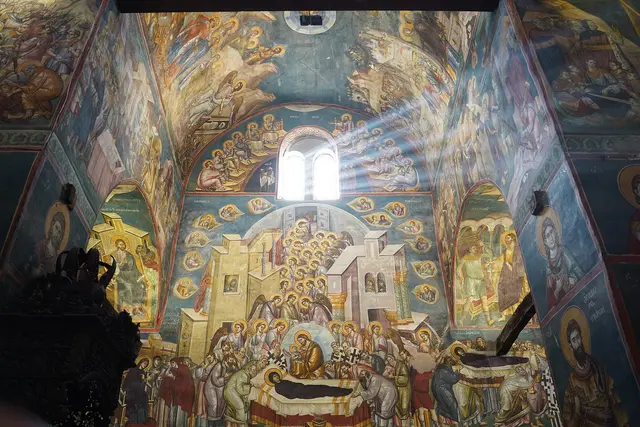
The Church of the Holy Mother of God Peribleptos in Ohrid was painted in 1294–1295 by Michael Astrapas and Eutychios. Its fresco programme is one of the major achievements of late Byzantine art.
Modern scholarship on the Dormition at Peribleptos specifically discusses star-shaped geometric forms added to the mandorla, the field of divine radiance surrounding the sacred figure.3 Here the geometry is explicitly Christian: light made visible, heaven rendered as form.
The example is important not because it proves a direct line from Philip II to a medieval painter, but because it shows how naturally stellar and radiating geometry remained at home in Macedonian sacred space.

Pelagonia, icons and stars carried into sacred art
The celebrated Mother of God Pelagonitissa from Zrze near Prilep dates to 1422. Its title itself connects the icon to Pelagonia.
Orthodox images of the Mother of God traditionally place stars on the maphorion, or veil, with a specifically Marian theological meaning. Those stars are not evidence that the painter intended an Argead political symbol. Yet they matter to the visual history of radiating forms in Macedonia because they show the star and rosette as a living sacred vocabulary rather than a forgotten archaeological curiosity.
Archaeological work in the Prilep region adds another layer. A 2023 study of medieval rings from roughly the tenth to fifteenth centuries records stars, rosettes, crosses, monograms, animals and biblical scenes among the motifs used on personal jewellery found at local sites.4
The radiating form was therefore not confined to church walls. It also entered objects worn on the body.
From sacred wall to personal object
The same heraldic study records solar decoration on women's regalia from Macedonia, including the pafta, a circular metal ornament worn at the belt, and the tepelak, a bridal headdress associated with the Ohrid region. It also describes sun-rosette ceiling carvings in traditional houses, where the central rosette represented light, heat and household dignity.2
This is an important shift in scale. The radiating form moves from royal funerary gold to shields, church painting, jewellery, bridal dress and the architecture of the home.
That is a much more persuasive way to speak about cultural preservation than claiming that one emblem remained unchanged for every century. The form survived because people repeatedly found places for it.

Before 1977: the evidence closest to the modern era
A radiating rosette inside St Demetrius
The Church of St Demetrius in Bitola was built in 1830, a date independently recorded by the Municipality of Bitola and the Pelagonia regional heritage authority.5
A historical photograph of a carved capital inside the church shows radiating rosette or sun-like forms. The church date does not automatically date every decorative detail to the year of construction, but the image is valuable because it places this geometry inside one of Bitola's best-known nineteenth-century sacred interiors.

The example that matters because it predates the excavation
The old Church of Sts Constantine and Helena at Razlovci is especially important to the continuity discussion.
The Municipality of Delčevo notes that no written construction record survives, but an icon dated 10 December 1859 establishes that the church had already been built by then.6 Local documentary photographs show eight- and sixteen-rayed painted forms inside the church. A widely circulated local documentation page dates the church to around 1850 and reproduces the motifs.7
Whatever the original painter intended the motifs to mean in their Christian setting, the chronological point is significant: eight- and sixteen-rayed forms were present in a Macedonian church more than a century before the royal tomb at Aigai was excavated in 1977.
That fact does not prove a hidden, uninterrupted memory of the Argead dynasty. It does something more defensible. It shows that the geometry itself already existed locally and did not need to be invented after the archaeological discovery.
Old doors, circular bosses and the honesty of uncertain provenance
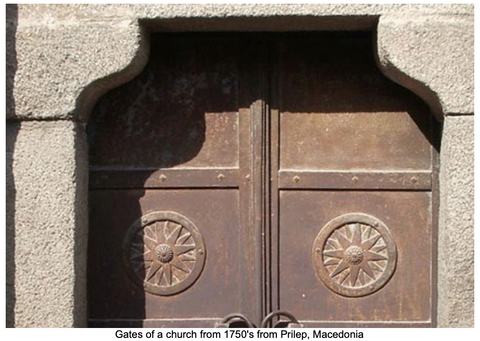
Historical photographs from Prilep show old doors carrying circular radiating bosses. Older online captions variously describe the doors as church or building gates and assign them to the eighteenth century, but the precise building provenance is not securely documented in a source strong enough for us to repeat it as fact.
So the image remains, but the claim is narrowed. It is presented as an old Prilep architectural example, not as a specifically identified church object. That is how heritage writing becomes stronger: by preserving what can be seen while refusing to invent what cannot yet be proved.
Not a frozen emblem. A visual memory.
When people say that a symbol was “preserved”, it is tempting to imagine a perfectly straight line: one generation consciously hands exactly the same emblem and meaning to the next.
History is rarely that tidy.
Symbols survive by being translated. A royal star can become a celestial image. A radiant disk can enter church decoration. A rosette can be carved into wood. A similar geometry can appear on a bride's headdress, a belt fitting, a ring or the centre of a household ceiling. Centuries later, an archaeological discovery can make one ancient version newly visible and give people a language for recognising a form that had long existed around them in other contexts.
This is why the church and folk material matters so much. It fills the space between antiquity and the twentieth century with actual objects, actual places and actual dates.
It does not prove that every later eight- or sixteen-rayed image was consciously “Argead”. It does show that the visual language of radiance remained alive in Macedonia long before the symbol became a modern state flag.
The strongest continuity is not the claim that nothing changed. It is the evidence that the radiating form kept finding a place in Macedonian life.Naš Nakit
The Sun becomes a modern Macedonian language
“A new sun of liberty”
The modern Macedonian relationship with the Sun did not begin with the 1992 flag.
At the end of 1941, Vlado Maleski wrote the text that would become the Macedonian anthem, Denes nad Makedonija. Its opening image is a new sun of liberty being born over Macedonia.8
The anthem's sun is not the sixteen-rayed royal starburst. It is something broader: freedom imagined as sunrise, a new day made into national poetry.
That distinction is important because it shows the depth of the solar idea in modern Macedonian identity. The archaeological discovery at Aigai had not yet happened. The independent republic did not yet exist. Yet the Sun was already being used to speak about Macedonia's future.
Freedom represented as sunrise
On 26 July 1946, the People's Republic of Macedonia adopted a state emblem with a mountain, river and a rising sun. A contemporary explanation published two days later in Nova Makedonija stated that the sun represented “the freedom and the creative life of Macedonia”.9
Again, this was not the sixteen-rayed Kutleš form. But that is precisely what makes the chronology meaningful. Long before the sixteen-rayed design became a flag, the Sun itself had already moved to the centre of Macedonian state symbolism.

The sixteen-rayed flag was being carried before there was an independent state
This is one of the most important facts in the modern history of the symbol.
The Macedonian Heraldic Society records the red flag with a golden sixteen-rayed Sun being used by the Macedonian diaspora in Australia in 1986. In the years that followed, it was used by Macedonian communities in Australia, Canada and the United States. The same source records the flag being flown publicly in Macedonia in the spring of 1990.10
So the sixteen-rayed flag was not designed by an independent Macedonian state and then handed down to the population. Macedonians in the diaspora were already carrying it.
For communities far from the homeland, symbols often become intensely personal. They stand for language, grandparents, villages, churches, music, memory and the feeling of belonging to somewhere that may be thousands of kilometres away.
The red field and golden Sun became that kind of image.
The state came after the attachment
Macedonia's independence referendum was held in September 1991. The sixteen-rayed flag was formally adopted by the Assembly on 11 August 1992.10
The sequence matters. Community use came first. State adoption followed.
For three years, the golden sixteen-rayed Sun on red became the national flag of the independent republic. In 1995, after the Interim Accord with Greece, it was replaced by the present red flag with a different eight-rayed solar design. The new flag was adopted on 5 October 1995.11
Even in that change, the central visual idea remained a sun.

A state symbol can change. A cultural symbol survives differently.
The sixteen-rayed Sun is no longer the state flag. Its public-state use also sits within the later legal framework created by the Prespa Agreement, which addresses use of the former flag symbol in official public contexts.12
But cultural life is not the same thing as official state usage.
For many Macedonians today, particularly in diaspora communities, the sixteen-rayed Sun remains a familiar expression of heritage and belonging. It appears at community events, in homes and halls, on clothing and keepsakes, in folk-cultural settings, and in jewellery. People continue to choose it even though legislation no longer requires them to.
That voluntary survival matters. A flag can be replaced in a parliament. A cultural image survives because families reproduce it, communities display it, craftspeople remake it, and younger generations still recognise themselves in it.
From symbol to modern heirloom

A form made intimate again
The Macedonian Sun translates naturally into jewellery because its geometry survives reduction. The centre holds the eye. The alternating rays create movement. Gold catches the light; silver sharpens the line; a ruby at the centre turns radiance into colour.
But the reason to wear it goes beyond geometry.
For a Macedonian, especially one living far from the places their family came from, a pendant can become a private version of something much larger: history, family, memory and belonging held close to the body.
That is what a modern heirloom can do. It does not pretend the past was simple. It gives the past another life.
Explore the Macedonian Sun CollectionThe Macedonian Sun does not need invented certainty to be extraordinary.
Its history is already rich enough: royal gold, medieval sacred art, folk ornament, nineteenth-century church decoration, songs of freedom, diaspora memory, a national flag, and a symbol still worn today. Heritage survives because people keep finding ways to carry it.
Sources & further reading
This article prioritises archaeological, municipal, academic and specialist heraldic sources. Where the precise provenance or date of a historical photograph cannot be independently verified, the caption is deliberately limited to what can be identified with confidence.
- UNESCO World Heritage Centre. Archaeological Site of Aigai (modern name Vergina). UNESCO identifies Aigai as the ancient royal capital of Macedonia and describes the palace, royal necropolis and discoveries of 1977–78.
- Jovan Jonovski. The Sun and the Lion as Symbols of the Republic of Macedonia: A Heraldic and Vexillological Analysis. Flag Heritage Foundation Monograph and Translation Series No. 8, 2020. Particularly relevant are the sections cataloguing ancient solar forms, medieval church examples at Nerezi, Matka, Staro Nagoričane and Lazarovci, women's regalia including pafta and tepelak, and traditional ceiling rosettes.
- Academic study of the Dormition mandorla. “The Mandorla Symbol in Byzantine and Post-Byzantine Iconography of the Dormition: Function and Meaning”, Religions 14 (2023), including discussion of star-shaped geometry at Holy Mother of God Peribleptos in Ohrid.
- Katerina Rosikopulos. “Religious and Symbolic Motif Rings from the Prilep Region: 10–16 Century”, Balcanoslavica 52 (2023). The study records star, rosette, cross, monogram and other motifs on medieval rings found in the Prilep region.
- Municipality of Bitola, Culture, and Pelagonia Region, Tourism and Culture. Both record the construction of St Demetrius in Bitola in 1830.
- Municipality of Delčevo. “Пораки од дамнина” / Messages from the Past, 23 April 2026. The municipality notes that no written construction record for the old Razlovci church survives, but an icon dated 10 December 1859 shows the church was already built.
- Local documentary archive. “Macedonian Sun – Razlovci”, reproducing photographs of eight- and sixteen-rayed forms inside the church. This is used as visual documentation rather than as the sole authority for the church's date.
- Macedonian Heraldic Society. Anthem of the Republic of Macedonia. The text was written by Vlado Maleski at the end of 1941 and opens with the image of a new sun of liberty.
- Macedonian Heraldic Society. Coat of Arms of the Republic of Macedonia. The 1946 contemporary explanation states that the rising sun represented freedom and the creative life of Macedonia.
- Macedonian Heraldic Society. The Flag with 16 Rayed Sun. Documents diaspora use in Australia from 1986, subsequent use in Canada and the United States, public use in Macedonia in 1990, and formal adoption on 11 August 1992.
- Macedonian Heraldic Society. Flag of the Republic of Macedonia. Records adoption of the present eight-rayed flag on 5 October 1995.
- Prespa Agreement, Article 8(3), signed 17 June 2018, concerning official use of the symbol formerly displayed on the national flag. The agreement concerns state/public usage and should not be confused with the separate social history of private and community use.
- Image sources. Wikimedia Commons image pages provide photographer and licence details for the openly licensed historical images used above. A small group of documentary images of Macedonian church, iconographic and ethnographic examples is credited to historyofmacedonia.org, the source to which the image set was originally attributed.
Editorial note on terminology. The design is known by several modern names, including the Macedonian Sun, Vergina Sun, Star of Vergina and Sun/Star of Kutleš. Ancient sources do not give us a surviving label explaining exactly what the maker of the Tomb II larnax called the design or what every ray represented. This article therefore uses “Macedonian Sun” as the cultural name familiar to the Naš Nakit audience while distinguishing securely documented history from later interpretation.
2 comments
This is a very interesting and informative article! The sixteen rays of the Macedonian Sun emblem were re-interpreted by the Church to signify the Cross. The original eight rays of the emblem were understood to refer to the equal-armed Cross or + transposed by the earlier Cross which was the first letter of Christ’s Name or X. The eight points referred to the numeric symbol for JESUS in the Hebrew numerology which is the number 8. The eight-rayed emblem was, in fact, the symbol taken over by the Romans who, as pagans, wore it on their helmets and shields. By adopting Christianity, St Constantine simply re-interpreted this symbol that was already on the helmets, shields and vexillols of his army to refer to Christ. Later the British, who saw themselves as inheritors of the legacy of Alexander – as the Romans did as well and who were the ones who first called him “Alexander the Great” whereas the Macedonians called him “Alexander the Invincible” – upon the creation of the British kingdom of England and Scotland, created the Union Banner which was and is a form of the Macedonian Star. The European imagination embraced Alexander the Great in such a manner so as to almost canonize him. He is often depicted even in stained glass windows in cathedrals, often being lifted to heaven by gryphons. The fabled “Romance of Alexander” has him prophesying the coming of the Messiah and recording his pledge to ensure that his descendants would submit to Him. Alexander and his Star continued to be feted via Alexandria – one of seventeen cities named for him – where there was the SOMA or tomb of Alexander who was formerly venerated as having achieved divinity. There is today a mosque dedicated to Alexander who is honoured as a prophet. His veneration as such also extends to some Ethiopian Orthodox who have adopted him as such as well! The Star of Vergina may also be seen in icons of St Sisoes the Great who was said to have come upon the tomb of Alexander and who wept over it.
My husband was Mile Todor Milosevski – I miss him alot. I love the Symbol of the ancient Sun very much. He admired Alexander The Great so I read up on that history as well. Very interesting.